
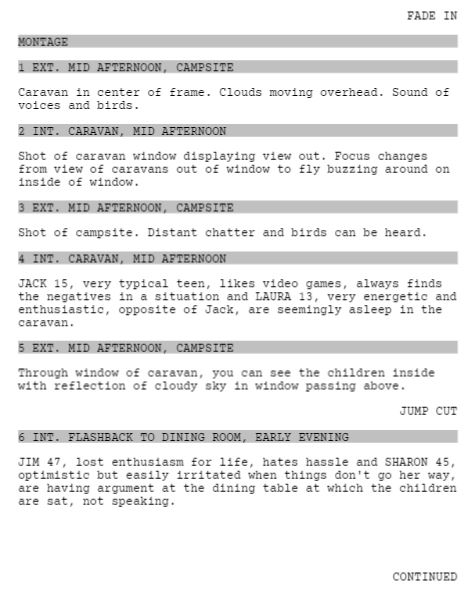
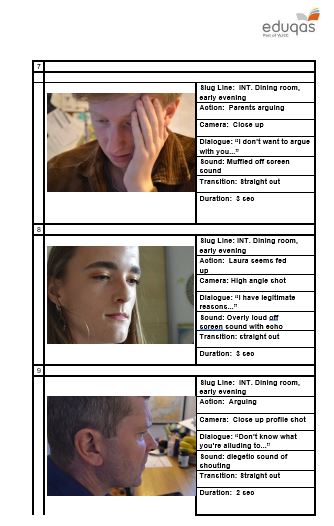
For my coursework element I have written a screenplay and produced a photo storyboard for a section of it. My screenplay follows a typical lower income family who are trying to go on a family weekend away to spend some well needed quality time together. You can instantly tell that it isn’t going to go as planned due to the use of an enigma at the beginning producing a feeling of doom. Here I am going to analyse and evaluate the narrative structure as well as meaning and response among other elements.
The short films I studied had quite a big impact on my own short film however I would say that Wasp by Andrea Arnold, 2003,had the greatest impact on me and my own film. I really wanted to incorporate social realist elements that were present in Wasp. I also wanted to keep the narrative storyline quite simple in terms of nothing too complicated or confusing happening because I feel this is detrimental to the overall effect of the film. This simple narrative is something that is present in Wasp, it following a linear, journey narrative. There are no flash-forwards or flash-backs, and there is no manipulation of the order of the sequence of the film, it just follows the journey of the family. This definitely enhances the social realist elements of the film as it is just going through time in a natural and realistic way, nothing fancy or unusual distracting from the characters or story line, simply regular people living their lives. I like this element, however I found that it was a little basic and that I could go a bit further to make it more interesting. I decided to mess with the sequence of time by starting the film with an enigma.
As I have mentioned the narrative element I chose to use was an enigma which comes in the form of a flash-forwards at the beginning of the film. The audience doesn’t know what is going on as the flash-forwards is out of context, you just get a feeling of impending doom. The narrative then reverts to the present day and the plot continues in a linear order, much like Wasp. I would say that I got inspiration for the flash-forwards at the beginning of my screenplay from Trainspotting. The opening scene of Trainspotting is a flash-forward to an event that plays out later in the film, showing the audience what led up to that moment. This effect is really effective at building tension.
Overall I would say my film is a journey narrative as it follows the family and their everyday life, but more specifically, the children. This narrative element means that the audience connects with the plot and the characters because they feel sorry for both the children and the parents for different reasons. I think due to the fact that the family in this film are relatable in their lifestyle, the audience aligns with the characters quicker. I would say that my film follows the three act structure, again, much like Wasp, and the other short films I have studied. The setup would be when you first meet the whole family and the parents are arguing over the dinner table and the children are just sat in silence trying not to listen. You really get a feeling of what family life is like in this moment, the audience either being able to empathise or sympathise with the characters and the general situation. This really helps the audience align with the characters from the off. This is something that is present in Wasp, the audience instantly getting a feel for what the characters are going through because of the narrative and the fact this film starts in medias res. This scene that I speak of in my own screenplay took inspiration from the opening scene of Wasp directly, when Zoe and her children are walking to an insignificant character’s house. There is an underlying feeling of pent up aggression and frustration which comes to the surface in front of us at this moment, a feeling I tried to convey in the beginning scene of my screenplay.
Throughout Wasp there are lots of little montages of establishing shots showing the surrounding neighbourhood, the council houses and that the area is quite run down. This really helps the audience see the economic situation of the characters in the film. These montages also give the film a very nostalgic feeling as well as a feeling of normality and that it’s just an ordinary day with ordinary people. There are also montages of shot-reverse-shots and POV shots in which there is a close up shot of a characters face and then a straight cut to the thing that they are looking at, whether that’s another character they are speaking to, or an object they are looking at. This is very helpful when establishing the surroundings and getting to know the characters as you feel close to them through the close up shots. You really get a sense of their emotions due to every little movement seen on their face. Its very raw and effective, especially with conveying the social realist elements. I tried to convey as many of these elements as I could in my own screenplay because I think they are very effective in creating an aesthetic and a nostalgic atmosphere. Some examples of where I conveyed this feeling would be the montage of the campsite at the beginning, including the shot of a buzzing fly in a caravan window. Highlighting these little details gives a film a richness because of the attention to detail.
Something else that I have tried to include in my screenplay is simplistic and realistic dialogue, the desired effect being to make it more relatable. This is seen in Wasp as there is a sparse dialogue which makes it very emotional and striking because the audience has lots of time to just think and absorb what they’re seeing and hearing. When the characters do speak its a very natural dialogue, there has been no build up because of the lack of speaking, its just people speaking when they have something to say, making it very realistic. There are no grand monologues or speeches and what is being said isn’t polished or an idealised version of what it is, its just real. The characters only really speak when they’re talking to each other or asking a question, none of it seems to be rehearsed or even like acting. I think I have successfully shown this in my screenplay as I tried to keep the dialogue as natural as possible, as if it were a real situation.
All of the films I took inspiration from had a lot of meaning behind them which means they had a significant audience response. In Wasp the main meaning is to not judge a book by its cover. This seems cheesy but definitely fits because at the beginning the audience gets a terrible impression of Zoe, the fact that she drags her children along to watch her have a fight with another fully grown adult being the worst part. You are instantly unsure about the welfare of the children, this just being human nature. Over the course of the film you gradually see that she isn’t so bad and that she really does feel for, and care for her children, she simply doesn’t have the means to look after them properly. I have done a similar thing in my screenplay, the flash-forwards at the beginning showing the children left by themselves in a dirty caravan before cutting back to the present day where the parents are having a loud and aggressive argument whilst they are just sat there. This instantly makes the audience question how the parents treat their children and whether they are being neglected or not. You later see evidence that there is love and care amongst the family, shown when the parents go and check on the children, suggesting a short holiday that they can use to spend quality time together. Even if it doesn’t go as they had originally planned, the intention was still there.
Smaller things such as audio and visual elements are important in my film as, like I previously mentioned, the smaller details are really important in making the film have an impact on the audience. I think the montages and clips of surrounding objects are important to this. The sound is very important whether it is dialogue or lack of, for example the ambient sound of a fly buzzing or the muffled sound of arguing from a child’s perspective. This detail is what I think gives my screenplay an effect much like the films I took inspiration from, mostly social realist films such as Wasp, Trainspotting and This is England. In Wasp there is no musical score, just the sound of the surroundings and some asynchronous sounds to add to the realist feeling of the film. This is incredibly effective in making the film relatable to everyone in the audience as there is nothing separating the film from real life, everything about it is true to the situation, no CGI or elaborate special effects, just people living their lives. The musical score really mirrors the narrative elements in this approach. The lack of any sort of musical score also means that in silent moments (obviously as there is not always dialogue) you can really hear the ambient sounds of the surroundings which puts the viewer on edge, especially when it comes to the situation the children are in. This use of ambient sound in moments which lack dialogue is something I have consciously incorporated because of how effective it is in wasp.
Overall all I would say that all the elements I have mentioned help create meaning and a visceral response for the audience, but I would say that narrative and audio are what create the most meaning because they really help you align with the characters in a subtle and natural way.
 Rosas Film Studies Blog