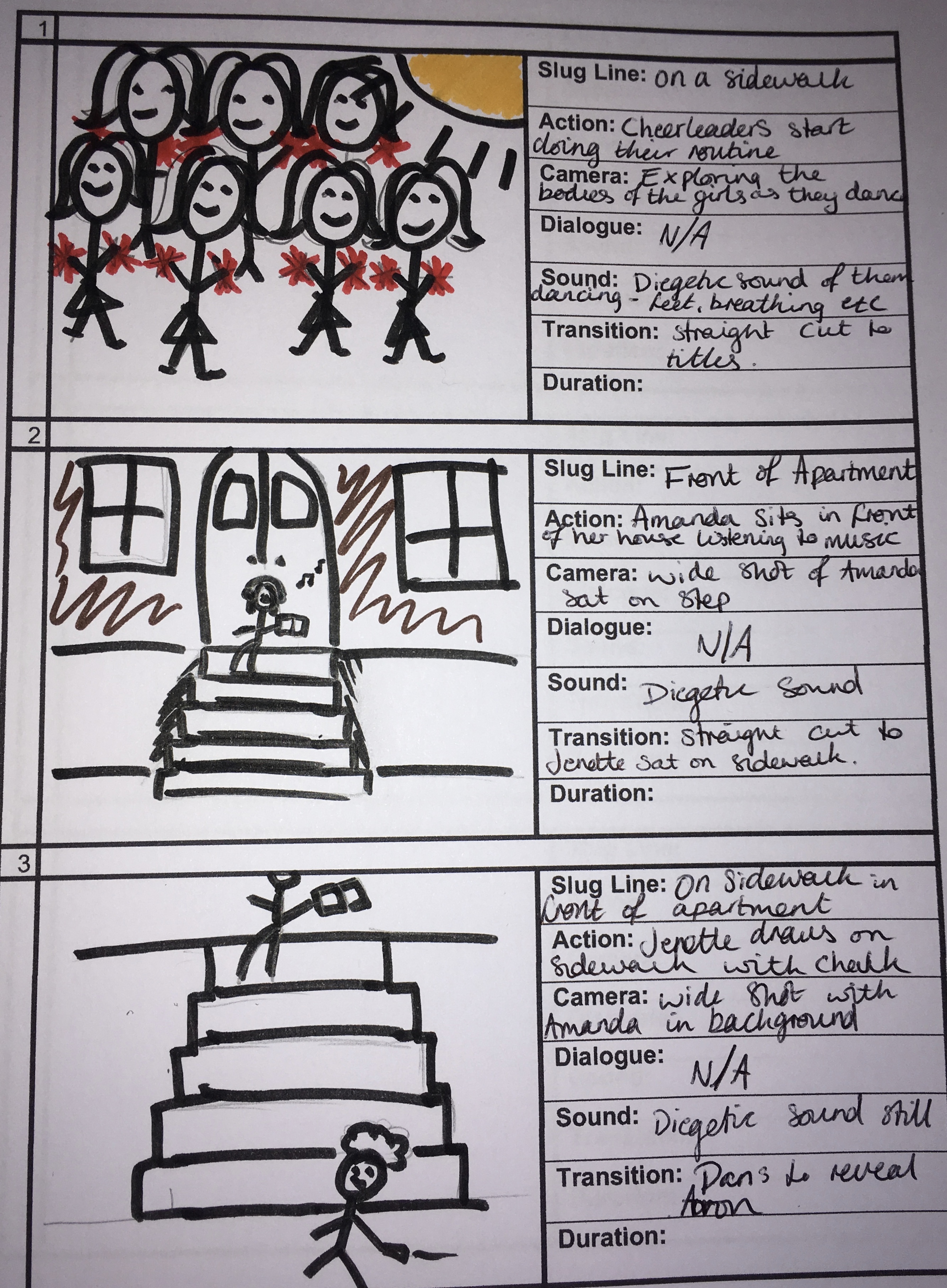
Here I have had a go at creating a basic storyboard (very basic), just to get to know the format. This is a small extract from the short film Five Feet And Rising by Peter Sollett from the website dailyscript.com.
Screenplay Training
Screenplay writing is the art and craft of writing scripts for feature films. Screenwriters are responsible for researching the story, developing the narrative, writing the screenplay, and delivering it, in the required format, to development executives. Screenwriters therefore have great influence over the creative direction and emotional impact of the screenplay and, arguably, of the finished film.
However, be aware you will be undertaking some rewriting and script doctoring as you create your peices. You will not create perfect script first time! Most produced films are rewritten to some extent during the development process.
With this there are two important elements of screenplay writing as seen above that link to the dramatic qualities of film and its effects on the audience. Therefore, these elements of screenplay writing have to be done right.
Dialogue: Dialogue is loaded with subtext (and can assist in character creation and alignment below), the river of emotion that flows beneath the words but remains unspoken—and subtext creates tension. Therefore, screenplay writers have to ensure that their dialogue has a visual impact. If dialogue is rehashing events that have already happened or is commenting on events that are happening instead of showing them, this will dilute tension rather than build it. If dialogue goes on for pages without pause, it will lack tension, no matter the subject. If dialogue contains chitchat, comments on the weather, greetings, compliments and other niceties, it also will lack tension. If dialogue is staged as experts or sages conveying information, the audience will become bored. Therefore, dialogue is important to get right to ensure dramatic tension within the audience Character Identification/Alignment: Scriptwriters aim to draw us into the narrative of films. Another important feature of this process is the generic aspect of characters: in mainstream films, characters are frequently cast in terms of the characters we like and those we don’t (crudely: heroes and villains). We are encouraged via the script/film to identify with characters, to become emotionally and psychologically involved with them, to feel as they do. Although or, perhaps, because these characters are highly idealized—they are more beautiful, brave, resourceful, etc. than any actual human being could be—viewers identify with them, thereby also taking themselves to be correlates of these ideal beings. But once we see the characters as versions of ourselves, their fates matter to us, for we see ourselves as wrapped up in their stories. Characters thus become a means of creating emotional responses in us.
Format features:
- single column with wide margins
- sequential page numbering (top right)
- mf (more follows) (bottom right)
- dialogue centred, with speaker’s name in upper case
- slugline and sound in upper case
- character name in upper case on first appearance only
- font – courier, 12 point
Content:
- each scene is numbered and accompanied with a slugline that consists of:
- an indication of where the action takes place – interior or exterior (INT, or EXT or INT/EXT)
- location descriptor
- lighting descriptor – DAY or NIGHT or TIME
- scene/action descriptor (with succinct descriptor of character on her/his first appearance)
- essential camera instructions (in upper case within scene descriptor) or essential editing instructions (in upper case, range right), which will only be used in exceptionalcircumstances (e.g. where SLO-MO is vital) It should be noted that screenplays do not typically include camera directions. action written in present tense.
 Rosas Film Studies Blog